
Why Axemere
The market is catching up to the problem we built Axemere to solve.
These aren't our claims: they're what the trade press is reporting about AI cost, governance, and control inside real organizations. Below each story is a note on how Axemere addresses it directly.
AI budgets are blowing up
This is the blind spot Axemere closes: real-time visibility into what every workload, team, and agent is spending before the bill arrives, plus hard budget caps so a runaway agent loop can't burn through a quarter's budget overnight.
projected rise in AI inference cost per agentic workflow, by 2028 — Gartner
AI Is Putting Pressure on the Corporate IT Budget
CIOs are cutting other IT spending to fund AI initiatives, and many still can't reliably measure the return.
Corporate America Is Starting to Ration AI as Cost Skyrockets
After a year of unrestricted rollout, companies are now rationing AI access as agentic workloads burn through annual budgets in months.
The Complicated Reality Behind AI Token Limits
Companies are testing individual token limits and usage expectations, trying to rein in cost without killing the productive use that justified the AI budget in the first place.
Companies Are Scrambling to Curtail Soaring AI Costs
The era of unrestricted usage is ending as AI agents rack up bills that can reach tens of millions of dollars a month.
Microsoft's AI Cost Problem: Tokens and Agents
Even Microsoft is pulling back on AI tool licenses as usage growth outpaces falling per-token prices.
Gartner Predicts AI Inference Costs Per Agentic Workflow Will Increase More Than Fivefold Through 2028
Falling per-token prices won't bail anyone out: agentic workflows burn far more tokens per task than a chatbot ever did, and Gartner projects inference cost per workflow will more than quintuple by 2028.
Scaling Enterprise AI Without Breaking the Bank: A CIO's Guide to AI Unit Economics
Makes the case that AI success is an economics problem, not a technology one, and recommends tracking cost per inference and routing workloads to right-sized models instead of treating spend as an afterthought.
Why Enterprise Software Is Becoming Harder—Not Easier—to Buy
AI-consumption pricing, token metering, and overlapping tools are making enterprise software costs harder to forecast across the board, not just on AI-specific line items.
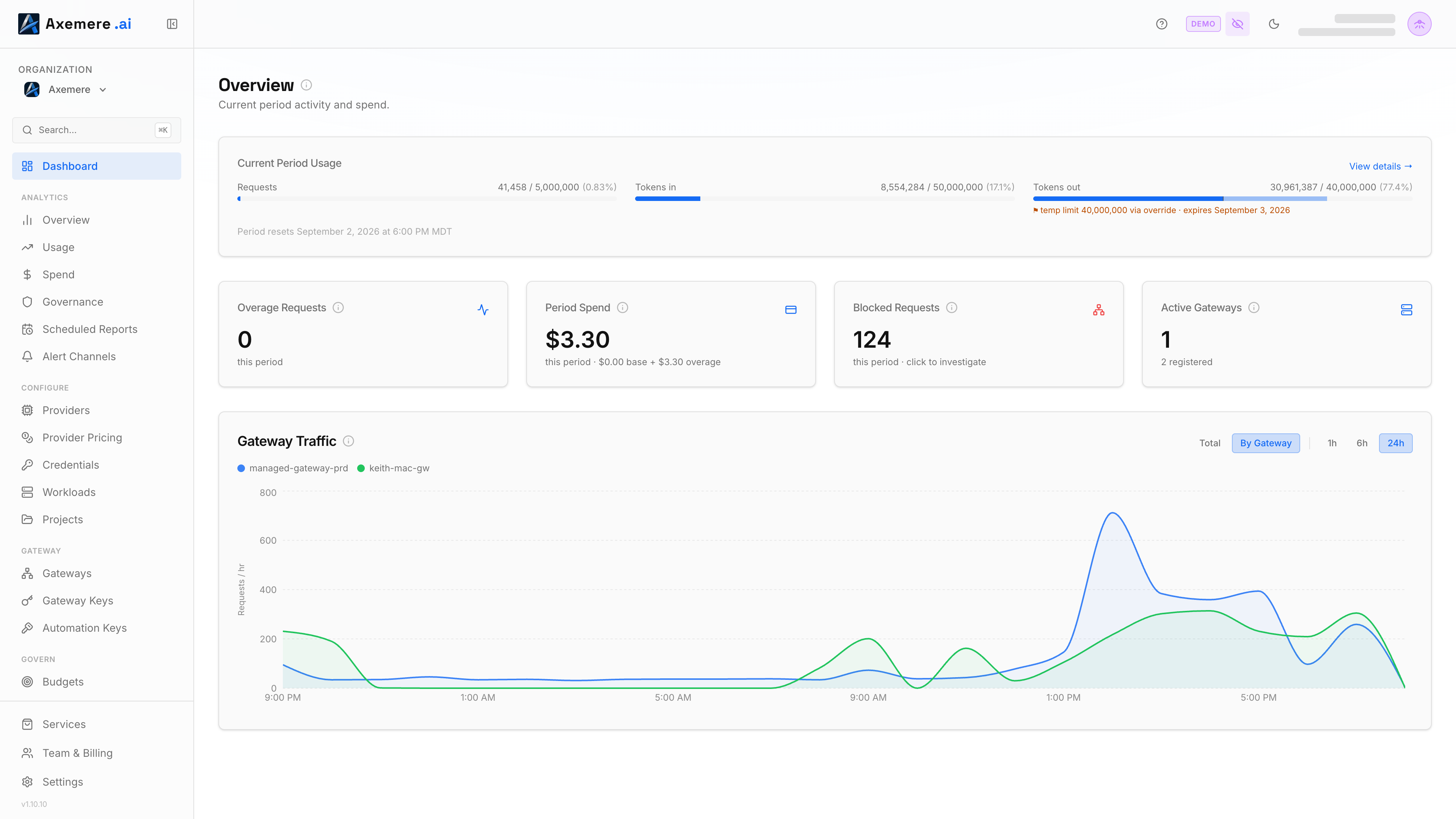
Every workload's spend, tokens, and blocked requests, updated in real time, not reconstructed after the invoice lands.
It's not one company — it's the pattern
Every company below spent real engineering time building usage caps, dashboards, and model-routing rules by hand, after the damage was already done. That's undifferentiated heavy lifting, not the thing that makes any of them money. Axemere gives you that visibility and control from day one, per workload, without writing a single line of internal tooling.
per tool, per engineer — Uber's new cap
Forbes
per employee — Tesla's new cap
The Information
cut in AI spend while usage kept growing — Coinbase
via X
cost jump on a routine tooling renewal — Priceline
TechCrunch
Uber Burns Its 2026 AI Budget In Four Months On Claude Code
Burned through its entire 2026 AI coding budget by April; now caps spend at $1,500 per tool, per engineer, per month.
The Token Bill Comes Due: Inside the Industry's Scramble to Manage AI's Runaway Costs
Microsoft canceled most Claude Code licenses for its Experiences + Devices division within six months of rolling them out, largely on cost.
Tesla Caps Employee AI Spend at $200 per Week After Adoption Push
Capped employee AI spending at $200 a week after some engineers ran up thousands of dollars weekly.
Amazon Says It Shut Down a Token Leaderboard: 'Don't Use AI Just to Use AI'
Shut down its internal AI usage leaderboard after employees inflated activity just to climb the rankings.
Walmart Caps Usage of an AI Tool for Employees After High Demand
Moved its in-house coding assistant from unlimited use to a fixed token allowance per employee.
The Token Bill Comes Due: Inside the Industry's Scramble to Manage AI's Runaway Costs
A Priceline finance director says a routine AI tooling contract renewal came back 4-5x more expensive than the year before.
How to Keep AI Spend Flat While Token Usage Grows Exponentially
Coinbase cut AI spend nearly in half while usage kept growing, by defaulting to cheaper models and smarter routing instead of hard caps.
JPMorgan Rolls Out Claude Changes: $2,000 Spending Limits and Extra Security
Capped Claude spending at $2,000 a month for selected employees, alongside added security controls, as usage of the tool expanded.
McKinsey's AI Cost Controls and Token Monitoring
Found that a small share of users accounted for a disproportionate amount of token consumption, and introduced usage alerts and governance measures in response.
Meta Moves to Curb Employee AI Usage as AI Costs Reach Billions
Rolled out real-time employee usage and spending monitoring, budgets, limits, and automated alerts after internal AI costs grew into the billions.
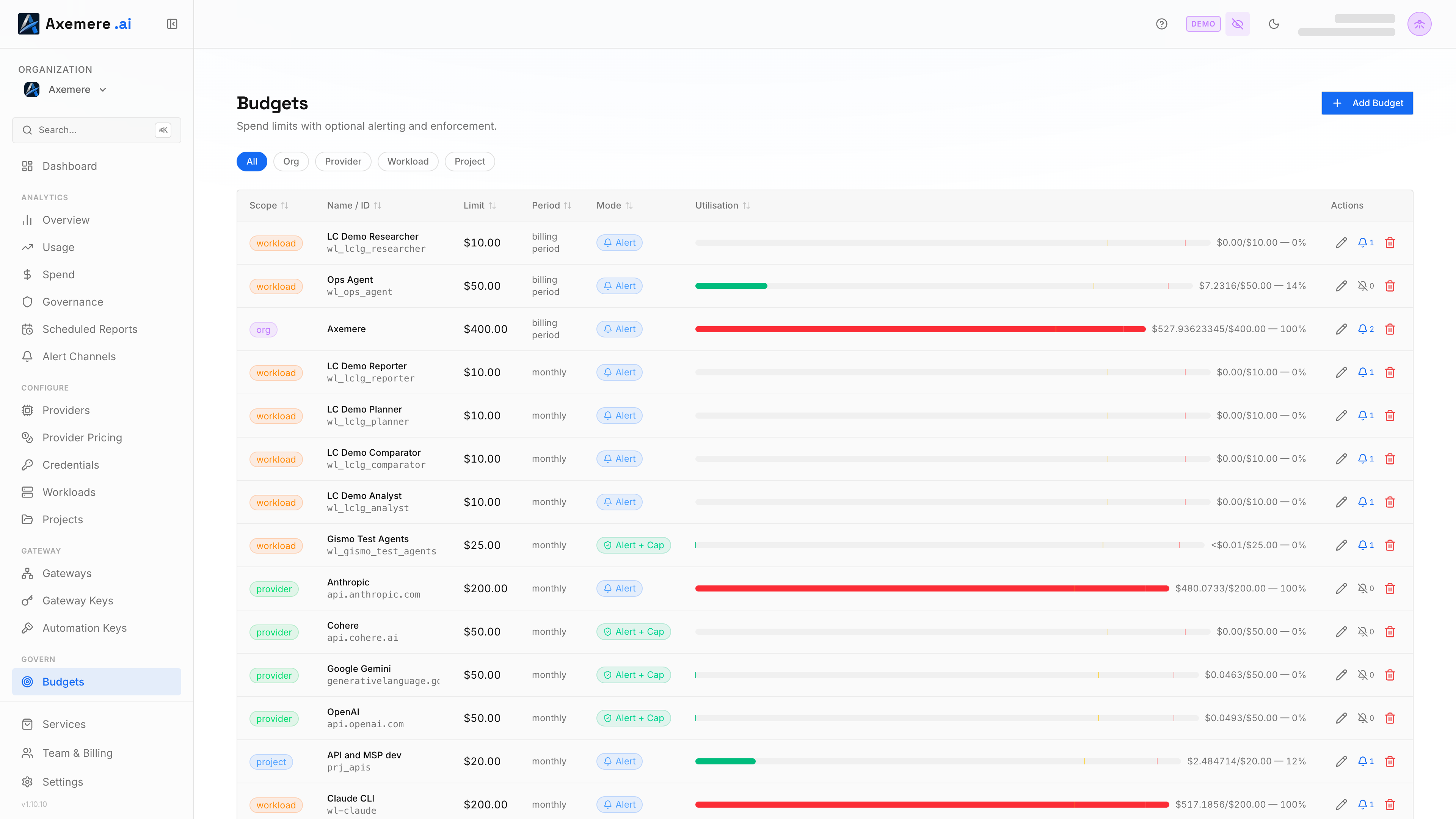
Hard caps at the org, provider, workload, or project level: set once, enforced automatically, no hand-rolled throttle.
Employees are already paying for AI you can't see
The fix isn't banning outside tools, it's removing the reason anyone reaches for one: fast, self-serve access to every major provider through a single governed gateway, so nobody has to put AI on a personal card just to get their work done.
There's no dashboard for money a company never sees, so the fix has to happen before it's spent: give teams a fast, self-serve path to real AI capability so there's no reason to reach for a personal card instead.
The CFO is now in the room
This is exactly the accountability muscle Axemere is built to serve: real chargeback by team, hard budget caps enforced automatically, and a spend trail any finance leader can audit, without asking engineering to build a dashboard first.
The top 20% of companies capture 74% of all AI-driven value. The rest split the remaining 26%. — PwC
CFOs Are Coming For The Enterprise AI Budget
OpenAI, Microsoft, and AWS are all racing to add spend limits and cost dashboards as CFOs start asking which team used what, and whether a cheaper model could have done the job.
AI's Last Mile Runs Through Finance
The technology isn't the bottleneck anymore: execution, cost transparency, and ROI discipline are, and CFOs are now the ones expected to own that gap.
The 5 Types of AI Investment and How to Capture Their Value
Most AI investment still doesn't show up in the numbers: McKinsey finds only 39% of companies can point to EBIT impact, and BCG puts the real payoff timeline at two to four years, not the seven to twelve months most teams expect.
How Leading Companies Generate ROI From AI
Just 20% of companies are capturing 74% of all AI-driven value. PwC's research points to measurement discipline, not the technology itself, as the difference.
AI's Finance Challenge: Managing Token Spend Without Slowing Innovation
Frames token consumption as a new enterprise resource line that finance has to forecast, allocate, and optimize against the value AI actually produces.
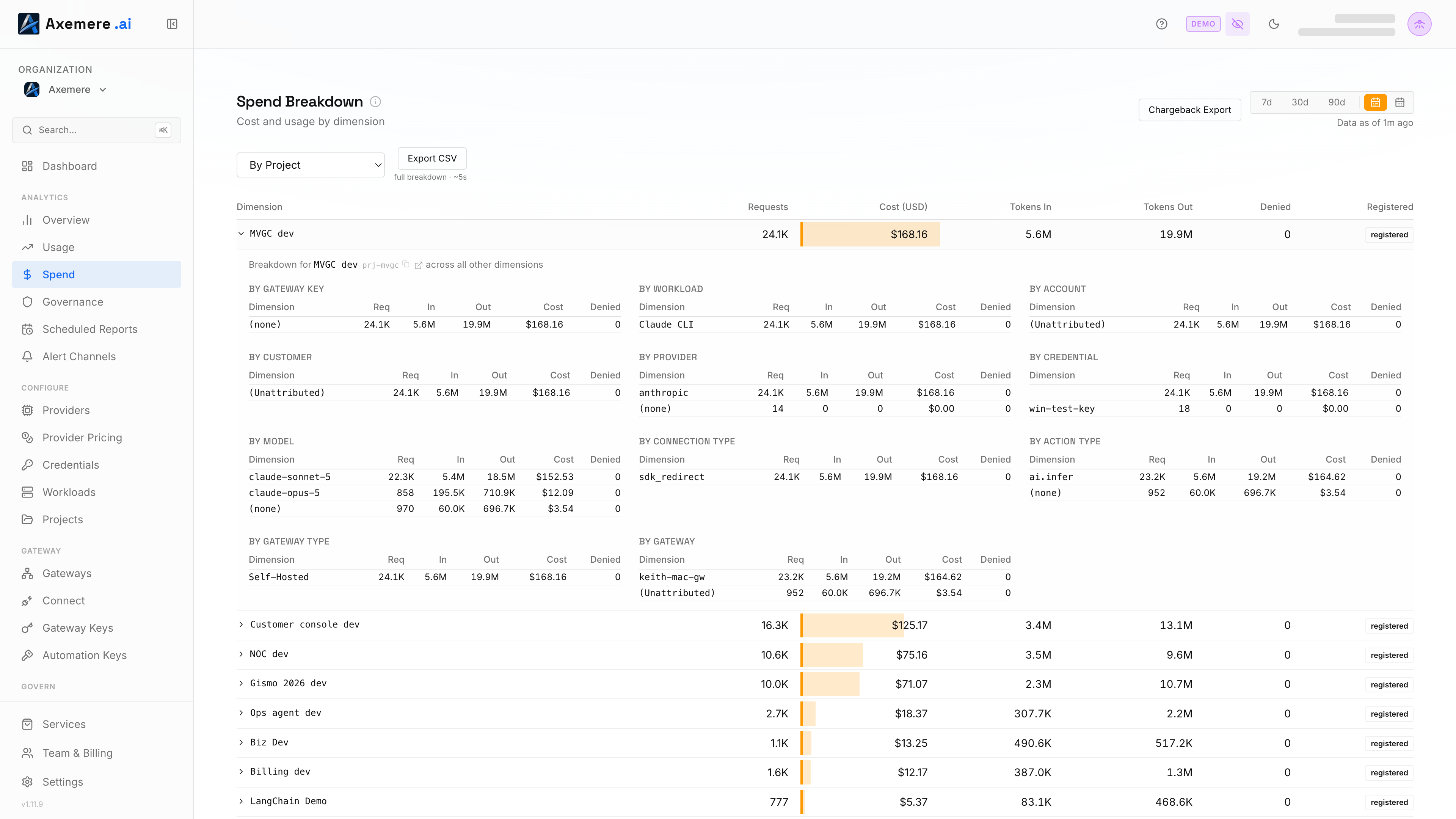
Spend broken down by project and team, exportable as a chargeback report finance can actually use.
Your AI gateway shouldn't be owned by someone else's roadmap
This is why Axemere is built and offered independent of any single AI lab or security vendor: a control plane that answers to you, not to whichever company happens to acquire the gateway you plugged into.
The Portkey Acquisition Is a Wake-Up Call
A gateway absorbed into a security vendor gets optimized for that vendor's priorities, not the full range of governance, finance, and routing needs an organization actually has.
Can Palo Alto Networks Route the Agentic Future Through Portkey's AI Gateway?
An independent analyst calls the deal's logic sound on paper, but warns folding gateway control into one security vendor's platform may add complexity rather than remove it.
There's no specific feature for this one: it's just who we are. Start free and see it running against your own traffic in minutes; no roadmap dependency on us or anyone else.