
That's the short answer. Here's what it actually looks like, end to end:
The whole idea, in one picture
Every app carries its own copy of the provider key. Nothing sits between your code and the provider, so there's no single place to set a rule, count a dollar, or write a record.
Adoption outran the controls
In the repo
Provider keys live on laptops, in CI secrets, and, often enough, checked into source where anyone with read access can find them. Rotating one means a code deploy.
At the invoice
The first time anyone sees what AI actually costs is the monthly bill. By then the spike is weeks old and nobody can say which team, project, or workload caused it.
“We think so”
Asked which requests were allowed and why, engineering produces log lines. A compliance reviewer has to take that on trust, because nothing is signed.
Four controls. Eight names.
Teams call these different things: "access control" and "credential management" describe the same requirement from two angles, and so do "cost attribution" and "spend attribution." Whichever name you use, it's one of these four. Pick one to see what it actually looks like.
Credential management
A fifth property cuts across all four rather than standing alone: it only counts as governance if it's consistent across every provider an organization uses, one policy engine and one audit trail per organization, not one per AI tool it adopted.
Can your team answer these right now?
Not "could we build it," can someone answer today, without a meeting. Answer honestly; nothing here is sent anywhere, it's computed in your browser.
Could you list every place a provider API key currently exists, including developer laptops?
If a key leaked right now, could you revoke it without shipping code?
Do you know what you've spent on AI so far this month, not last month?
Can you say which project or workload drove your largest AI cost line?
Is there one rule set about allowed models that every service actually follows?
Could an auditor verify which requests were allowed, without taking engineering's word for it?
Answer the questions to see where the gaps are.
30-day free trial · no credit card
Governed traffic in about 60 seconds
Axemere is a gateway and control plane that sits in front of every AI provider an organization uses. Run it yourself, let Axemere run it, or both across a fleet: the governance model doesn't change based on who operates the infrastructure.
Step 01
Point your SDK at the gateway
One base URL change. No new client library, no code rewrite. Your provider key comes out of the app and stays in the gateway.
from anthropic import Anthropic

client = Anthropic(
  base_url="https://us.gw.axemere.ai/proxy/anthropic/k/gwk_live_...",
  api_key="unused",  # provider key never leaves the gateway
)
Step 02
Tag who it's for
Optional headers turn a request into an attributable one: the signal spend attribution and policy scoping key off of.
X-MVGC-Project-ID: checkout-api
X-MVGC-Workload-ID: refund-triage
X-MVGC-Account-ID: acct_8812
Step 03
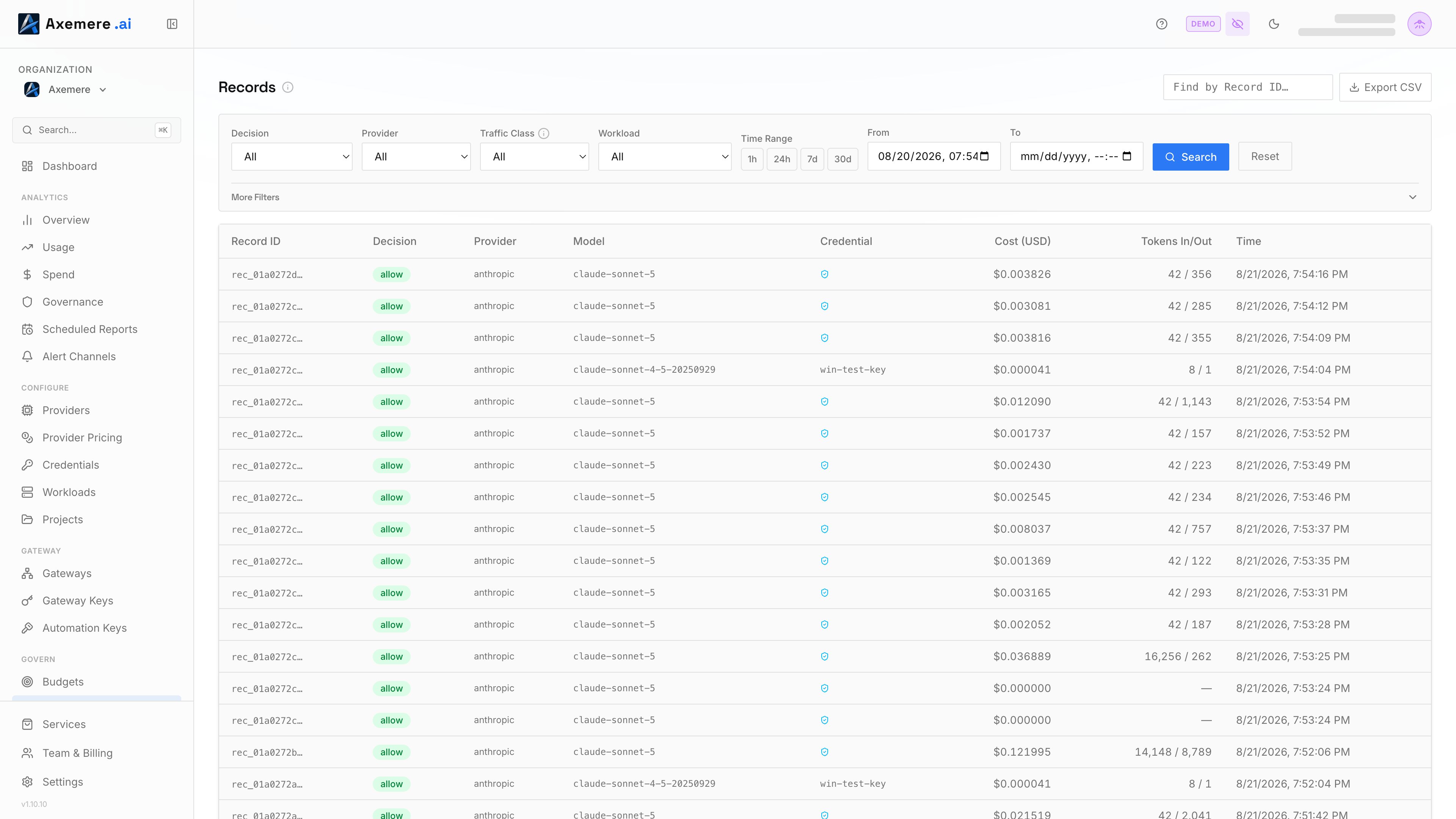
Watch it land
Spend appears in the console as it happens, the policy decision is attached, and the signed record is written. Nothing else to wire up.
Depends who's asking
If you're an engineer
You want to know what it does to your request path.
One extra hop, one environment variable, and the same provider SDKs you already use. Self-host it if you'd rather not add a vendor to the critical path.
If you own the budget
You want the number before the invoice, and a cap that holds.
Real-time spend by project, workload, or account, plus hard caps at any of those levels, enforced at the gateway rather than requested politely.
If you own compliance
You want evidence you didn't have to trust engineering for.
Signed, Merkle-anchored execution records your auditors can verify independently, including the denials, and the reason each one was denied.
The objections, up front
See all four working together, on requests you actually make
Start a 30-day free trial and watch credential isolation, policy enforcement, spend attribution, and the audit trail land on real traffic, in minutes, not a procurement cycle.
30 days · no credit card required