
Google Cloud just validated AI cost governance as a category. Here's what it still can't do.
In August 2026, Google Cloud shipped real budget caps, anomaly detection, and cost-governance tooling for Gemini Enterprise. It's a genuinely good investment in FinOps for Google spend. The moment your team also calls OpenAI or Anthropic, which is the norm rather than the exception, it's fragmented again.
The short answer
Google's new billing and cost-control tools for Gemini Enterprise are real product investment, not a marketing announcement: pay-as-you-go pricing, pooled quotas, spend caps with anomaly detection, and savings plans. All of it is scoped to Google's own products. Most teams running AI in production today already route across four or more providers simultaneously. A billing tool that only sees Google spend can't give that team one budget picture, no matter how good the tooling gets. That's the gap a multi-provider governance layer like Axemere closes.
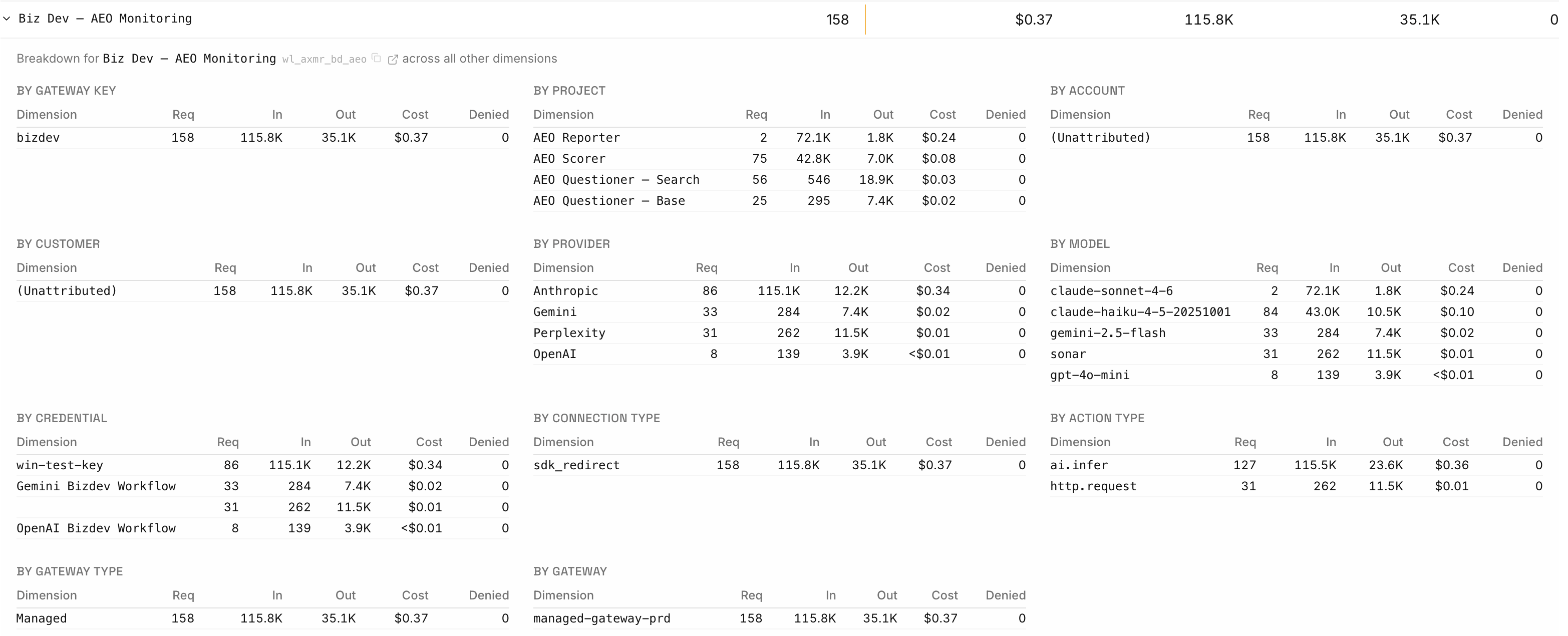
This is Axemere's own internal dogfooding usage, not a customer's data, which is why the dollar amounts are small. What it demonstrates isn't the total: it's that every request is attributed to the penny across provider, model, project, credential, and workload at the same time. The "By Provider" row shows Anthropic, Gemini, OpenAI, and Perplexity spend in one view, the same multi-provider picture the row above argues Google's tooling structurally can't show you.
What Google announced
Google Cloud's August 2026 announcement added billing flexibility and governance tooling across Gemini Enterprise, Google Antigravity, and Android Studio. The pieces worth knowing:
- Pay-as-you-go pricing for Gemini Enterprise, rolling out broadly, alongside the existing per-seat subscription.
- Pooled, project-wide quotas across business apps, developer tools, and custom agents, instead of separate per-tool allowances.
- Deferred execution pricing (coming soon): mark a workload as deferred and Google's scheduler runs it in off-peak capacity for up to half the inference cost.
- Flexible Savings Plans: 10% off for a 1-year commitment or 20% off for 3 years, no minimum spend, drawing down against an existing Google Cloud Enterprise Agreement.
- Spend caps with anomaly detection in the Cloud Billing Console: a firm monthly limit that pauses API calls when hit, alerts at 50/80/100%, and root-cause analysis that names the top SKUs driving a spend spike.
- A "FinOps agent" that generates natural-language cost summaries for leadership.
The anomaly detection and natural-language reporting in particular read as substantial, well-built features, not a stopgap or a checkbox. It's also entirely Google-ecosystem: the announcement doesn't mention OpenAI, Anthropic, or any non-Google provider anywhere.
Where governance requirements diverge
This isn't a case of Google's tooling being immature or narrow by oversight. It's scoped to Google spend because Google is a model provider, not a neutral governance layer sitting in front of every provider a team uses. The dividing line is structural, not a feature gap that a future release closes.
One provider's view of a multi-provider budget
A spend cap that only sees Gemini calls can't stop, or even show you, an overage on OpenAI or Anthropic. The moment a team uses more than one provider, which is the common case, the cap covers a fraction of the actual spend at risk.
Policy that has to be reimplemented per provider
Google's governance tooling lives inside Google Cloud's own billing console. A rule like "sensitive requests need human approval" or "only this workload can call this model" has to be rebuilt separately for every other provider a team adds, instead of enforced once, centrally.
Credential handling and audit trail stay out of scope
Google doesn't need to solve credential vaulting for its own first-party APIs, and the announcement is a billing story, not a compliance-audit story. Neither shows up in it. A team that needs a tamper-evident record a reviewer outside engineering can independently verify still needs that layer.
When each makes sense
If your team is genuinely single-cloud, running only Gemini models with no plans to add another provider, Google's native billing and cost tools are a real, well-built option that covers the job. If your team already calls more than one provider, or expects to, which is the norm for teams running AI in production at scale, a single provider's billing console can't give you one budget picture or one policy surface across all of them. That's the layer Axemere adds: one control plane, one spend picture, and one audit trail across every provider your team actually uses, including Google's.
There's a second difference worth naming: who this is actually built for. Google's tooling isn't formally locked to large enterprises: Flexible Savings Plans are available to self-serve customers as well as enterprise-agreement customers, and the new pay-as-you-go pricing has no minimum spend. But everything around it is shaped for an enterprise-structured org. Gemini Enterprise itself starts around $21-30/seat/month before any AI usage happens, the announcement's own language (lines of business, Enterprise Agreements, a dedicated FinOps agent) assumes an actual FinOps function and a billing-console admin, and the plan's flagship pitch, folding new spend into an existing Enterprise Agreement without fragmenting it, is only meaningful if you already have one. A small team that wants to sign up and set a budget cap in minutes, with no seat commitment and no console to administer, isn't really who this was written for, even where it's technically reachable. That's what Axemere's Growth Pack is built for: $25/month, self-serve, no procurement, with budget caps and alerts included from the first dollar.
See every provider's spend in one place
Start a 30-day free trial and set your first cross-provider budget cap in minutes, no matter how many AI providers your team already calls.