
Policies
For: Platform operators and policy authors configuring policy bundles on Axemere Gateway.
Configuration Overview | Credentials | Workloads | Policies
Policies are organized into a bundle that controls evaluation order and expiry, and rule files that contain the actual governance rules.
Table of Contents
- 3.1 Bundle file
- 3.2 Rule files
- 3.3 Rule fields
- 3.4 Condition language
- 3.5 Effect language
- 3.6 Per-layer rule files
- 3.7 Additional bundle files
- 3.8 Complete examples
- 3.9 Policy Add-Ons
- 4. Pushing policies at runtime
- 5. Policy file locations by installation method
- See also
3.1 Bundle file
Location: configs/policies/bundle.yaml (or pushed via the admin API)
The bundle is the root of the policy configuration. It sets global defaults and controls which layers are evaluated, in what order.
Default bundle (skeleton + add-ons)
The default bundle.yaml shipped with the gateway is a skeleton -- it contains no rules of its own. Instead, rules are loaded automatically from the addons/ subdirectory under MVGC_POLICIES_DIR. This is the add-on system described in section 3.9.
schema: mvgc.policy_bundle.v1
bundle_id: default
version: "1.0.0"
issued_at: "2026-03-15T00:00:00Z"
expires_at: "2028-03-15T00:00:00Z"

defaults:
  decision: deny
  trace_level: matched_rules

evaluation:
  order:
    - identity
    - connectors
  stop_on:
    - deny
  merge_strategy: first_match
On startup, the gateway detects that the bundle has no inline_rules and no files: list. It then scans <MVGC_POLICIES_DIR>/addons/ and loads every .yaml file found there (symlinks are followed automatically). This means enabling or disabling a provider is as simple as placing or removing a file in addons/ and calling POST /v1/admin/policies/reload -- no restart required.
Advanced: file-referenced or inline bundles
For production governance with explicit per-layer rule files, use mvp_policy.yaml (see section 3.7) or write your own bundle. Three loading modes are supported:
# Mode 1: skeleton (default) -- loads add-ons from addons/ automatically
schema: mvgc.policy_bundle.v1
# ... no files: or inline_rules: ...

# Mode 2: file-referenced -- loads named rule files from MVGC_POLICIES_DIR
files:
  - targets.yaml
  - credential-rules.yaml
  - budgets.yaml
  - risk.yaml
  # transforms.yaml is optional; the binary embeds a default and uses it when absent

# Mode 3: inline -- embeds rules directly (used for admin API pushes and tests)
inline_rules:
  identity:
    - id: identity.allow.proxy
      priority: 100
      when:
        field: context.connection_type
        equals: connect_proxy
      effect:
        decision: allow
inline_rules takes precedence over files. Both take precedence over the add-on loader. A bundle with a non-empty files: or inline_rules: section never loads from addons/.
Bundle signature
signature:
  alg: ed25519
  kid: "kid_cp_policy_1"
  sig: "base64url..."
Populated by the CP when MVGC_BUNDLE_SIGN=true. See Signed Policy Bundles.
Bundle field reference
| Field | Type | Required | Description |
|---|---|---|---|
schema | string | yes | Must be mvgc.policy_bundle.v1. |
bundle_id | string | yes | Unique bundle identifier. |
version | string | yes | Version string (any format). |
issued_at | RFC3339 | no | When the bundle was issued. |
expires_at | RFC3339 | no | The gateway rejects the bundle after this time. |
defaults.decision | string | yes | Decision applied when no rule matches. Typically deny. See decision valid values. |
defaults.trace_level | string | no | How much detail to include in policy traces. See defaults.trace_level valid values. |
defaults.require_receipt | bool | no | When true, every execution must be recorded in the ledger. |
evaluation.order | []string | yes | Layer evaluation order. |
evaluation.stop_on | []string | no | Decisions that halt evaluation early. See decision valid values. |
evaluation.merge_strategy | string | no | How multiple matching rules are combined. See evaluation.merge_strategy valid values. |
signature | object | no | Ed25519 signature for bundle integrity. Verified when MVGC_BUNDLE_VERIFY_SIGNATURES=true. |
files | []string | no | Relative paths to policy rule files (used with filesystem bundles). |
inline_rules | map | no | Rules embedded directly in the bundle. Keyed by layer name. Takes precedence over files. |
proxy.managed_domains | []string | no | Per-bundle HTTPS domains to intercept (merged with gateway-level MVGC_MANAGED_DOMAINS). |
proxy.bypass_domains | []string | no | Domains to explicitly pass through even if they match managed_domains. |
defaults.trace_level valid values
| Value | Description |
|---|---|
none | No trace included in the execution record. |
summary | Final decision and matched layer names only. |
matched_rules | Includes the IDs of all rules that matched. |
full | Full evaluation detail including all context fields and rule outcomes. |
evaluation.merge_strategy valid values
| Value | Description |
|---|---|
first_match | Stop at the first rule that matches within a layer. Recommended. |
most_specific | Apply the most specific matching rule (by priority). |
priority | Evaluate all rules; apply the one with the lowest priority number. |
3.2 Rule files
Each policy layer has its own YAML file. Rules in each file share the same schema and layer tag.
Rule file structure
schema: mvgc.policy_rules.v1
layer: identity
rules:
  - id: identity.allow.all.explicit
    description: "Allow all explicit action requests"
    priority: 100
    when:
      field: context.connection_type
      equals: direct_api
    effect:
      decision: allow
      reason: "explicit action request allowed"
Rule file header fields
| Field | Type | Description |
|---|---|---|
schema | string | Must be mvgc.policy_rules.v1 or mvgc.rule_file.v1. |
layer | string | The evaluation layer this file belongs to. |
rules | []Rule | The list of policy rules. |
3.3 Rule fields
| Field | Type | Required | Description |
|---|---|---|---|
id | string | yes | Unique rule identifier. Included in policy traces. Convention: <layer>.<effect>.<target>. |
description | string | no | Human-readable explanation of the rule's intent. |
priority | int | yes | Lower numbers are evaluated first within a layer. Ties are resolved by file order. |
when | Condition | no | Match expression. When omitted, the rule always matches. |
effect | Effect | yes | The outcome when the rule matches. |
3.4 Condition language
Conditions are YAML objects that evaluate fields from the request context.
Logical combinators
# All sub-conditions must match
when:
  all:
    - field: context.connection_type
      equals: direct_api
    - field: context.attribution.project_id
      exists: true

# Any sub-condition must match
when:
  any:
    - field: action.target_host
      equals: api.openai.com
    - field: action.target_host
      equals: api.anthropic.com
Combinators can be nested to any depth.
Leaf operators
| Operator | Type | Description | Example |
|---|---|---|---|
equals | string | Exact string match | equals: api.openai.com |
in | []string | Value is in the list | in: ["api.openai.com", "api.anthropic.com"] |
not_in | []string | Value is not in the list | not_in: ["api.evil.com"] |
exists | bool | Field is present and non-empty | exists: true |
regex | string | RE2-compatible regex match | regex: "^proj-[0-9]+" |
prefix | string | String starts with value | prefix: "proj-" |
suffix | string | String ends with value | suffix: ".openai.azure.com" |
lt | decimal string | Numeric less-than | lt: "1.00" |
lte | decimal string | Numeric less-than-or-equal | lte: "0.00" |
gt | decimal string | Numeric greater-than | gt: "2.00" |
gte | decimal string | Numeric greater-than-or-equal | gte: "0.50" |
Numeric operators accept decimal strings to avoid floating-point imprecision. Use quoted values like "1.00", "0.75".
Context field reference
Fields are addressed as dotted paths. All paths under context.* or action.* are valid.
Identity and ingress:
| Field | Description |
|---|---|
context.org_id | Organization ID of the caller |
context.workload_id | Workload ID of the calling service |
context.connection_type | direct_api, sdk_redirect, or connect_proxy |
context.delegation_id | Delegation token ID, if present |
context.principal_id | Principal identity |
Action:
| Field | Description |
|---|---|
context.action.type | Action type: ai.infer, http.request, etc. |
context.action.method | HTTP method: GET, POST, etc. |
context.action.target_host | Target hostname (e.g. api.openai.com) |
context.action.target_path | Target URL path |
context.action.params.<key> | Action parameter by key (e.g. context.action.params.model) |
context.action.headers_present | Comma-separated list of present header names |
context.action.header.<name> | Value of a specific request header |
action.target_host | Shorthand for context.action.target_host (usable in inline rules) |
Attribution:
| Field | Description |
|---|---|
context.attribution.customer_id | Customer identifier |
context.attribution.account_id | Billing account identifier |
context.attribution.project_id | Project identifier |
context.attribution.labels.<key> | Label value by key |
Cost estimates:
| Field | Description |
|---|---|
context.estimates.tokens_in | Estimated input tokens |
context.estimates.tokens_out_max | Estimated maximum output tokens |
context.estimates.cost_usd_max | Estimated maximum cost as decimal string |
Budget state:
| Field | Description |
|---|---|
context.budgets.org_usd_remaining | Remaining org budget as decimal string |
context.budgets.project_usd_remaining | Remaining project budget as decimal string |
Risk signals:
| Field | Description |
|---|---|
context.risk.score | Composite risk score (0.0 to 1.0) |
context.risk.request_rate | Recent request rate (requests/minute) |
context.risk.cost_rate | Recent cost rate (USD/minute, decimal string) |
context.risk.signals | Active signal names (e.g. rate_spike, cost_anomaly) |
Delegation:
| Field | Description |
|---|---|
context.delegation_id | Token ID from the delegation token |
delegation.actions_allow | Actions allowed by the delegation scope |
delegation.targets_allow | Targets allowed by the delegation scope |
Connector candidates:
| Field | Description |
|---|---|
context.candidates.connectors | List of eligible connector IDs |
context.candidates.credentials | List of eligible credential IDs |
3.5 Effect language
The effect block defines what happens when a rule matches. Effects can produce a decision, modify the request, or select infrastructure.
decision valid values
| Value | HTTP Status | Description |
|---|---|---|
allow | 200 | Proceed with the request. |
deny | 403 | Reject the request. |
downgrade | 200 | Allow but mutate the request (e.g. swap model). Use with mutate. |
require_approval | 202 | Pause and create an approval request. Returns approval_id. |
rate_limit | 429 | Throttle the caller. Returns Retry-After header. Use with rate_limit. |
quarantine | 403 | Reject and create a quarantine record for review. Use with quarantine. |
require_attribution | 403 | Reject with an attribution-specific reason. |
Credential selection
Credential IDs referenced here must be registered -- see Credentials.
effect:
  # Select by ID (preferred):
  select_credential: cred-openai

  # Or with explicit struct:
  select_credential:
    credential_id: cred-openai

  # Or select by attributes (policy engine picks the first match):
  select_credential:
    provider: openai
    mode: alias
    billing_owner: customer
| Field | Type | Description |
|---|---|---|
credential_id | string | Exact credential ID to use. |
provider | string | Filter by provider name. |
mode | string | Filter by credential mode. See Credentials -- mode valid values. |
billing_owner | string | Filter by billing owner. See Credentials -- billing_owner valid values. |
Connector selection
effect:
  select_connector:
    connector_id: openai
Valid connector IDs match the provider values in the credentials provider table: openai, anthropic, gemini, azure_openai, cohere, generic_http.
Attribution enforcement
effect:
  enforce_attribution:
    require:
      - project_id
      - account_id
    allow_overrides:
      - project_id
      - labels
| Field | Type | Description |
|---|---|---|
require | []string | Attribution fields that must be present. Request is denied if any are missing. Valid values: customer_id, account_id, project_id, labels. |
allow_overrides | []string | Attribution fields the caller may override. |
Default attribution
effect:
  default_attribution:
    customer_id: cust-default
    account_id: acct-default
    project_id: proj-default
    labels:
      env: prod
Applies before enforce_attribution. Fields are only set if not already present in the request.
Budget enforcement
effect:
  enforce_budget:
    limit_key: "project:proj-123"
    max_usd_per_day: "200.00"
    max_usd_per_request: "2.00"
| Field | Type | Description |
|---|---|---|
limit_key | string | Budget scope key (e.g. project:proj-123, org:org-001). |
max_usd_per_day | decimal string | Daily spend cap. |
max_usd_per_request | decimal string | Per-request cost cap. |
Request mutation
Use mutate with decision: downgrade to rewrite action parameters:
effect:
  decision: downgrade
  mutate:
    action.params.model: "gpt-4o-mini"
    action.headers.X-Cost-Tier: "economy"
    action.target_path: "/v1/chat/completions"
    action.method: "POST"
  reason: "model downgraded due to cost threshold"
Valid mutate key prefixes:
| Prefix | Description |
|---|---|
action.params.<key> | Set an action parameter |
action.headers.<name> | Set a request header |
action.target_host | Override the target hostname |
action.target_path | Override the target path |
action.method | Override the HTTP method |
Rate limiting
effect:
  decision: rate_limit
  rate_limit:
    key: "org"
    limit: 100
    window: "1m"
| Field | Type | Description |
|---|---|---|
key | string | Rate limit bucket key. "org" uses the org ID; any string is allowed. |
limit | number | Maximum requests per window. |
window | duration | Time window (e.g. "1m", "5m", "1h"). |
Quarantine
effect:
  decision: quarantine
  quarantine:
    reason: "critical risk score exceeded threshold"
| Field | Type | Description |
|---|---|---|
reason | string | Human-readable reason stored in the quarantine record. |
Require receipt
effect:
  require_receipt: true
When true, overrides the bundle default and requires this execution to be recorded in the ledger.
3.6 Per-layer rule files
Default configuration uses add-ons. The per-layer files described in this section are used with
mvp_policy.yamland thefiles:loading mode for production governance. The out-of-the-boxbundle.yamlloads rules from theaddons/directory instead. See section 3.9 for the add-on system.
The mvp_policy.yaml bundle evaluates five rule-file layers. Identity filtering and delegation token checks are handled by gateway-level configuration settings (see allowed_connection_types and the connector settings below) rather than policy rules.
Rules within a layer are evaluated in ascending priority order; the lowest priority number runs first. With merge_strategy: first_match, evaluation stops at the first matching rule in each layer.
Gateway-level enforcement settings
Two behaviours that were formerly expressed as policy rules are now controlled by gateway config settings, keeping the policy files focused on per-request governance logic:
| Setting | Config key | Env var | Default | Description |
|---|---|---|---|---|
| Allowed connection types | gateway.allowed_connection_types | MVGC_ALLOWED_CONNECTION_TYPES | (all) | Comma-separated list of permitted connection types (direct_api, sdk_redirect, connect_proxy). Empty = all permitted. |
| Allow generic HTTP connector | connectors.allow_generic_http | MVGC_ALLOW_GENERIC_HTTP | true | When false, the generic HTTP fallback connector is disabled; only named AI-provider connectors are available. |
# configs/mvgc.yaml
gateway:
  allowed_connection_types:
    - direct_api
    - sdk_redirect
    - connect_proxy   # remove to disable HTTPS proxy interception gateway-wide

connectors:
  allow_generic_http: true     # set to false to restrict to AI providers only
3.6.1 targets.yaml
Path: configs/policies/targets.yaml
Controls which upstream hostnames the gateway will forward requests to. This is the primary safeguard against requests being routed to unauthorized external services. Rules match on context.action.target_host, which is the hostname extracted from the request (explicit action requests use action.target_host; proxy mode uses the HTTP Host header).
Default rules:
schema: mvgc.policy_rules.v1
layer: targets
rules:
  - id: targets.allow.openai
    priority: 100
    when:
      all:
        - field: context.action.target_host
          in: ["api.openai.com"]
    effect:
      decision: allow
      reason: "openai target allowed"

  - id: targets.allow.anthropic
    priority: 100
    when:
      all:
        - field: context.action.target_host
          in: ["api.anthropic.com"]
    effect:
      decision: allow
      reason: "anthropic target allowed"

  - id: targets.allow.gemini
    priority: 100
    when:
      all:
        - field: context.action.target_host
          in: ["generativelanguage.googleapis.com"]
    effect:
      decision: allow
      reason: "gemini target allowed"

  - id: targets.allow.azure_openai
    priority: 100
    when:
      any:
        - field: context.action.target_host
          suffix: "openai.azure.com"
        - field: context.action.target_host
          suffix: "cognitiveservices.azure.com"
    effect:
      decision: allow
      reason: "azure openai target allowed"

  - id: targets.deny.unknown
    priority: 1000
    when:
      all:
        - field: context.action.target_host
          not_in: ["api.openai.com", "api.anthropic.com", "generativelanguage.googleapis.com"]
    effect:
      decision: deny
      reason: "target host not in allowlist"
Note on the deny rule:
targets.deny.unknownuses anot_inlist that intentionally omits Azure hostnames -- those are caught bytargets.allow.azure_openaiat priority 100 before the deny rule at priority 1000 is reached. If you add providers, add both an allow rule for them and include their hostnames in thenot_inlist of the deny rule (or replace the catch-all approach entirely with a single deny rule at the bottom that matches everything).
Common customizations:
# Add a private or on-premise LLM endpoint:
- id: targets.allow.private-llm
  priority: 100
  when:
    field: context.action.target_host
    equals: llm.internal.corp.example
  effect:
    decision: allow
    reason: "internal LLM endpoint allowed"

# Restrict a workload to a single provider:
- id: targets.deny.non-openai.billing-app
  priority: 150
  when:
    all:
      - field: context.workload_id
        equals: wl-billing-app
      - field: context.action.target_host
        not_in: ["api.openai.com"]
  effect:
    decision: deny
    reason: "billing-app may only reach OpenAI"
3.6.2 credential-rules.yaml
Path: configs/policies/credential-rules.yaml
Selects which credential to use for each request and enforces attribution requirements. Credential selection rules match on the target host (and optionally on workload, ingress mode, or attribution fields) and set both select_connector and select_credential together. The catch-all deny at the bottom rejects any request that does not match a credential rule -- typically because project_id is missing.
Default rules:
schema: mvgc.policy_rules.v1
layer: credentials
rules:
  - id: creds.select.openai.prod
    priority: 100
    when:
      all:
        - field: context.action.target_host
          equals: api.openai.com
        - field: context.attribution.project_id
          exists: true
    effect:
      select_connector:
        connector_id: openai
      select_credential:
        credential_id: cred-openai
        provider: openai
        mode: alias
        billing_owner: customer
      enforce_attribution:
        require:
          - project_id
      decision: allow
      reason: "openai credential selected"

  # Identical pattern for creds.select.anthropic.prod, creds.select.gemini.prod,
  # creds.select.azure_openai.prod -- each matches on target_host + project_id
  # and selects the corresponding credential.

  - id: creds.deny.missing.project
    priority: 500
    when:
      all:
        - field: context.attribution.project_id
          exists: false
    effect:
      decision: deny
      reason: "project_id is required for attribution"
Every credential selection rule requires project_id to be present in the attribution block. The select_connector and select_credential effects work together: select_connector routes to the provider-specific connector, select_credential tells the connector which API key to use.
Common customizations:
# Add a second OpenAI credential for a different team:
- id: creds.select.openai.team-b
  priority: 90
  when:
    all:
      - field: context.action.target_host
        equals: api.openai.com
      - field: context.workload_id
        prefix: "wl-team-b-"
      - field: context.attribution.project_id
        exists: true
  effect:
    select_connector:
      connector_id: openai
    select_credential:
      credential_id: cred-openai-team-b
    enforce_attribution:
      require:
        - project_id
    decision: allow

# Apply default attribution before the attribution check:
- id: creds.default.attribution
  priority: 60
  effect:
    default_attribution:
      project_id: proj-unattributed
3.6.3 budgets.yaml
Path: configs/policies/budgets.yaml
Enforces cost caps at both the per-request and per-project-per-day levels. Cost estimates are computed by the gateway from the request body before this layer runs and are available as context.estimates.cost_usd_max. Daily spend state is tracked in Postgres and available as context.budgets.project_usd_remaining.
Default rules:
schema: mvgc.policy_rules.v1
layer: budgets
rules:
  # Hard-deny if a single request's estimated cost exceeds $2.00.
  - id: budgets.deny.request.cap
    priority: 100
    when:
      all:
        - field: context.estimates.cost_usd_max
          gt: "2.00"
    effect:
      decision: deny
      reason: "per-request cost cap exceeded (max $2.00)"

  # Hard-deny if the project has exhausted its daily budget.
  - id: budgets.deny.project.daily.exhausted
    priority: 50
    when:
      all:
        - field: context.budgets.project_usd_remaining
          lte: "0.00"
    effect:
      decision: deny
      reason: "project daily budget exhausted"

  # Downgrade the model when estimated cost is high but under the hard cap.
  - id: budgets.downgrade.high.cost
    priority: 200
    when:
      all:
        - field: context.action.type
          equals: ai.infer
        - field: context.estimates.cost_usd_max
          gt: "1.00"
    effect:
      decision: downgrade
      mutate:
        action.params.model: "gpt-4o-mini"
      reason: "cost estimate exceeds threshold; downgrading model"
Rule priority determines the order: exhausted daily budget (priority 50) is caught before the per-request cap (100), which is caught before the downgrade (200). A request with an estimated cost over $2 is denied outright; one between $1-$2 has its model swapped to gpt-4o-mini instead.
Estimates vs actuals:
context.estimates.cost_usd_maxis a pre-execution estimate based on input token count and model pricing. It may be conservative.context.budgets.project_usd_remainingreflects actual committed spend from previous requests. Use both together for effective budget governance.
3.6.4 risk.yaml
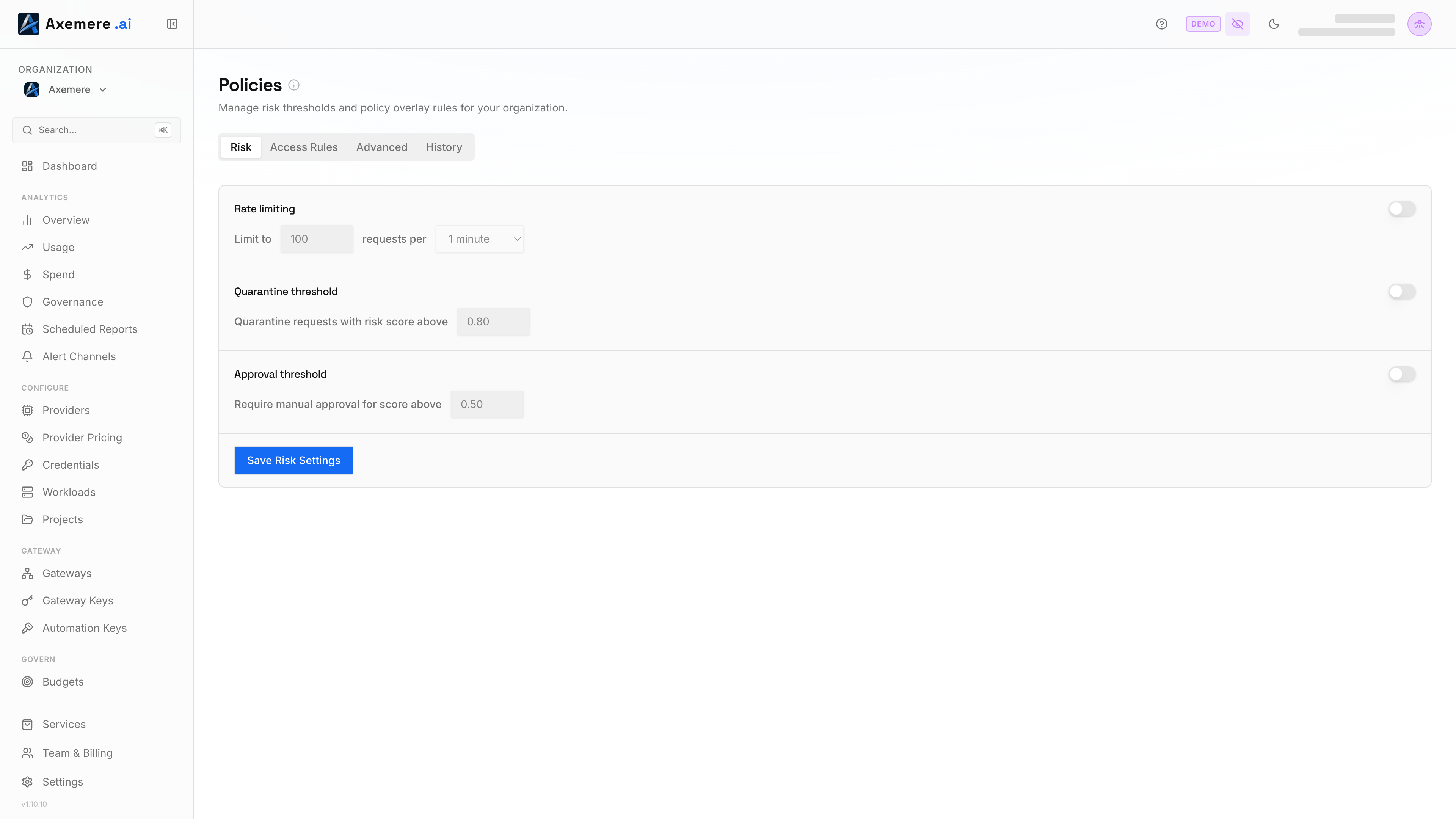
Path: configs/policies/risk.yaml
Applies automated governance based on the composite risk score and real-time signal data computed by the gateway's risk scorer before policy evaluation. The risk scorer populates context.risk.score (0.0--1.0) and context.risk.signals using a sliding time window.
Risk score signals:
| Signal | Weight | Triggers when |
|---|---|---|
rate_spike | 0.40 | Requests in the last 1m > 3× the baseline avg req/min (over 5m window). Requires ≥5 baseline observations. |
cost_anomaly | 0.30 | USD spend in last 1m > 3× the baseline avg USD/min. Same minimum baseline guard. |
target_diversity | 0.15 | Distinct target hosts in last 1m > 3× the baseline rate from the 1m–5m prior window (the recent window is excluded from baseline to avoid it always subsuming itself). Requires ≥3 recent hosts. |
time_of_day | 0.15 | Current time falls outside MVGC_RISK_BUSINESS_HOURS (format: HH:MM-HH:MM,TZ). Only fires if the env var is set. |
Signals require at least five observations in the baseline window before activating. A newly started gateway or a workload with very few requests will not trigger risk rules even if the score appears elevated.
Default rules:
schema: mvgc.policy_rules.v1
layer: risk
rules:
  # Application-tagged high-risk requests require approval.
  - id: risk.require_approval.high_cost
    priority: 100
    when:
      field: context.action.params.risk_tier
      equals: "high"
    effect:
      decision: require_approval
      reason: "risk tier requires manual approval"

  # Automated quarantine for critical risk scores.
  - id: risk.quarantine.critical
    priority: 10
    when:
      field: context.risk.score
      gt: "0.8000"
    effect:
      decision: quarantine
      quarantine:
        reason: "automated quarantine: risk score exceeds critical threshold"

  # Require approval for elevated but non-critical risk scores.
  - id: risk.approval.elevated
    priority: 20
    when:
      field: context.risk.score
      gt: "0.5000"
    effect:
      decision: require_approval
      reason: "elevated risk score requires approval"

  # Rate limit callers with a request rate spike.
  - id: risk.ratelimit.burst
    priority: 30
    when:
      field: context.risk.request_rate
      gt: "100.00"
    effect:
      decision: rate_limit
      rate_limit:
        key: "org"
        limit: 100
        window: "1m"
Rules fire in priority order: critical quarantine (10) -> approval for elevated (20) -> rate limit burst (30) -> application-supplied risk_tier tag (100). Because the bundle's stop_on includes quarantine and rate_limit, hitting any of the first three rules stops further layer evaluation immediately.
Common customizations:
# Lower the quarantine threshold for a stricter posture:
- id: risk.quarantine.strict
  priority: 10
  when:
    field: context.risk.score
    gt: "0.6000"
  effect:
    decision: quarantine
    quarantine:
      reason: "strict mode: quarantine threshold 0.60"

# Require approval specifically for off-hours requests:
- id: risk.approval.off-hours
  priority: 25
  when:
    field: context.risk.signals
    in: ["time_of_day"]
  effect:
    decision: require_approval
    reason: "off-hours request requires approval"
3.6.5 transforms.yaml
Path: configs/examples/transforms.yaml
The last layer evaluated before connector execution. Used for non-security mutations to the outgoing request: injecting headers, normalizing paths, or swapping models. Because this layer only runs after all deny/allow/rate-limit decisions have already been made, mutations here are guaranteed to apply only to requests that have fully passed governance.
Default rules:
schema: mvgc.policy_rules.v1
layer: transforms
rules:
  # Inject an Axemere tracking header on every forwarded request.
  - id: transforms.header.request_id
    priority: 100
    effect:
      mutate:
        "action.headers.X-MVGC-Request-ID": "injected"

  # Supply a default path when the caller omitted one.
  - id: transforms.path.api_version
    priority: 200
    when:
      field: context.action.target_path
      exists: false
    effect:
      mutate:
        "action.target_path": "/v1/"
The X-MVGC-Request-ID rule has no when clause and therefore matches every request. The path normalization rule only fires when target_path is absent.
mutatewithoutdecision: When a transform rule omits thedecisionfield, it applies the mutation while leaving the existing decision unchanged. This is the correct pattern for header injection and path normalization. Usedecision: downgradeonly when the mutation itself represents a policy downgrade (e.g., swapping a premium model to an economy model).
Common customizations:
# Inject attribution as a header for downstream audit:
- id: transforms.header.project
  priority: 100
  when:
    field: context.attribution.project_id
    exists: true
  effect:
    mutate:
      "action.headers.X-Project-ID": "{{context.attribution.project_id}}"

# Normalize gpt-4 to the current recommended version:
- id: transforms.model.gpt4.normalize
  priority: 150
  when:
    field: context.action.params.model
    equals: "gpt-4"
  effect:
    mutate:
      "action.params.model": "gpt-4o"
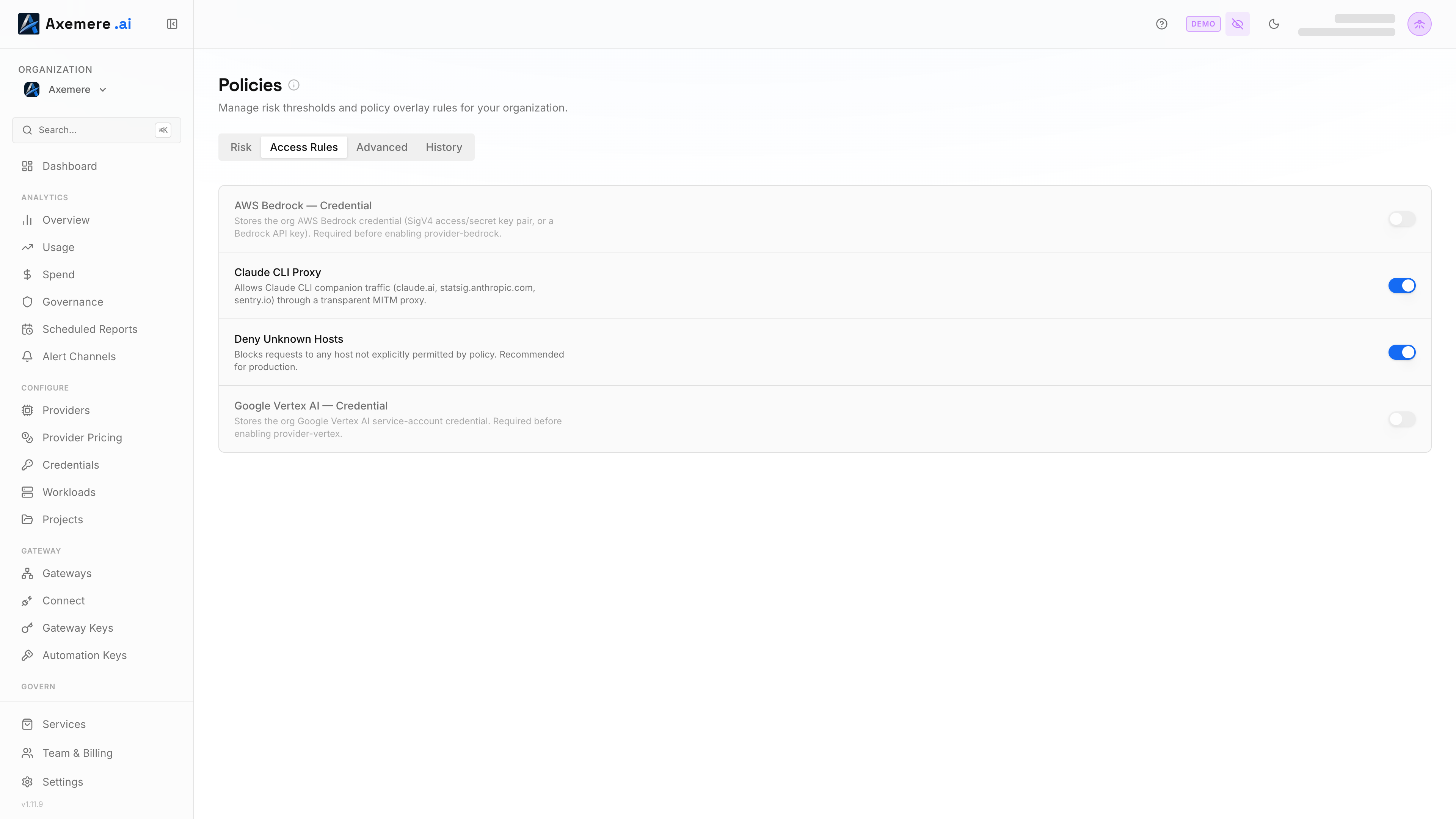
3.6.6 Access Rules (console)
The hosted console's Policies → Access Rules tab exposes four organization-wide toggles that wrap common credential and proxy behaviors without hand-editing YAML:
| Toggle | Effect |
|---|---|
| AWS Bedrock — Credential | Stores the org AWS Bedrock credential (SigV4 access/secret key pair, or a Bedrock API key). Required before enabling provider-bedrock. |
| Claude CLI Proxy | Allows Claude CLI companion traffic (claude.ai, statsig.anthropic.com, sentry.io) through a transparent MITM proxy; the console equivalent of the proxy: key described in proxy-mitm.yaml. |
| Deny Unknown Hosts | Blocks requests to any host not explicitly permitted by policy. Recommended for production; equivalent to the proxy.deny.unknown-host rule in proxy-credentials.yaml. |
| Google Vertex AI — Credential | Stores the org Google Vertex AI service-account credential. Required before enabling provider-vertex. |
The two credential toggles (AWS Bedrock, Google Vertex AI) stay disabled until the corresponding credential is configured; enabling them makes that provider selectable elsewhere in the console (Providers, Credentials).
3.7 Additional bundle files
Beyond the add-on system and the eight per-layer rule files, the configs/policies/ directory ships two standalone complete bundles. These are not loaded automatically -- they are templates and reference configurations intended to be pushed via the admin API.
mvp_policy.yaml
Path: configs/examples/mvp_policy.yaml
The full production-ready bundle. Unlike bundle.yaml (which loads add-ons from addons/ and evaluates the connectors layer only), mvp_policy.yaml loads named rule files for the targets, credentials, budgets, risk, and transforms layers and configures a strict stop_on list.
schema: mvgc.policy_bundle.v1
bundle_id: "bundle-mvp-001"
version: "2026.03.06.1"
issued_at: "2026-03-06T00:00:00Z"
expires_at: "2027-03-06T00:00:00Z"

defaults:
  decision: deny
  require_receipt: false
  trace_level: matched_rules

evaluation:
  order:
    - targets
    - credentials
    - budgets
    - risk
    - transforms
  stop_on:
    - deny
    - require_approval
    - require_attribution
    - rate_limit
    - quarantine
  merge_strategy: first_match

files:
  - targets.yaml
  - credential-rules.yaml
  - budgets.yaml
  - risk.yaml
  # transforms.yaml is optional; the binary embeds a default and uses it when absent
Comparison with bundle.yaml (the default startup bundle):
bundle.yaml | mvp_policy.yaml | |
|---|---|---|
| Rules location | Add-ons loaded from addons/ | External files via files: |
| Layers evaluated | connectors (from add-ons) | targets, credentials, budgets, risk, transforms |
| Attribution enforcement | None | require_attribution in stop_on |
stop_on | deny only | deny, require_approval, require_attribution, rate_limit, quarantine |
| Intended use | Quick-start, proxy mode | Full production governance |
To activate mvp_policy.yaml:
curl -X PUT http://localhost:7080/v1/admin/policies \
  -H "MVGC-Admin-Token: $MVGC_ADMIN_TOKEN" \
  -H "Content-Type: application/yaml" \
  --data-binary @configs/examples/mvp_policy.yaml
After pushing, edit the individual layer files (targets.yaml, credential-rules.yaml, etc.) and push the bundle again to pick up changes. The file paths in files: are resolved relative to MVGC_POLICIES_DIR.
proxy-credentials.yaml
Path: configs/examples/proxy-credentials.yaml
A minimal single-layer bundle that maps AI provider hostnames to their credentials. It evaluates only the connectors layer and is intended as a customization template for transparent proxy credential routing.
schema: mvgc.policy_bundle.v1
bundle_id: proxy-credentials
version: "1.0.0"
...
evaluation:
  order:
    - connectors
  stop_on:
    - deny
  merge_strategy: first_match

inline_rules:
  connectors:
    - id: proxy.allow.openai
      when:
        field: action.target_host
        equals: api.openai.com
      effect:
        decision: allow
        select_credential: cred-openai

    - id: proxy.allow.anthropic
      when:
        field: action.target_host
        equals: api.anthropic.com
      effect:
        decision: allow
        select_credential: cred-anthropic

    # ... gemini, azure_openai, cohere ...

    - id: proxy.deny.unknown-host
      priority: 500
      when:
        field: action.target_host
        exists: true
      effect:
        decision: deny
        reason: "no credential configured for this target host"
This bundle is not loaded on startup and does not include identity, targets, budgets, risk, or transforms layers -- it performs only hostname-to-credential routing. Use it as a starting point when you need to:
- Override which credential maps to a specific provider
- Add custom Azure deployment hostnames (
<resource>.openai.azure.com) - Add non-standard or private LLM endpoints
- Restrict which hosts the transparent proxy will forward to
Push a customized copy to replace the active bundle:
cp configs/examples/proxy-credentials.yaml my-proxy-config.yaml
# Edit my-proxy-config.yaml to add or change host mappings, then:
curl -X PUT http://localhost:7080/v1/admin/policies \
  -H "MVGC-Admin-Token: $MVGC_ADMIN_TOKEN" \
  -H "Content-Type: application/yaml" \
  --data-binary @my-proxy-config.yaml
proxy-mitm.yaml
Path: configs/examples/proxy-mitm.yaml
An example bundle showing the proxy: key, which controls per-workload SSL MITM domain
scope when MVGC_PROXY_MITM_ENABLED=true. This is the only bundle file that uses the
proxy: top-level key; it is otherwise a normal bundle and may include any policy rules.
schema: mvgc.policy_bundle.v1
bundle_id: proxy-mitm-example
version: "1.0.0"
issued_at: "2026-03-19T00:00:00Z"
expires_at: "2027-03-19T00:00:00Z"

# Per-bundle MITM domain scope.
# managed_domains: intercept these hosts (merged with MVGC_MANAGED_DOMAINS).
# bypass_domains:  always pass through even if they match managed_domains.
proxy:
  managed_domains:
    - api.openai.com
    - "*.anthropic.com"
    - generativelanguage.googleapis.com
  bypass_domains:
    - telemetry.anthropic.com

defaults:
  decision: deny

evaluation:
  order:
    - identity
    - connectors
    - targets
  stop_on:
    - deny
  merge_strategy: first_match
The proxy: key is validated at bundle load time. Empty strings in either list are
rejected. The bypass_domains list is checked first; a domain that matches both lists
is treated as bypassed.
When to use each bundle:
| Scenario | Approach |
|---|---|
| Getting started, transparent proxy with env var credentials | bundle.yaml (default, loads add-ons from addons/) |
| Production governance with all eight policy layers | Push mvp_policy.yaml via admin API |
| Customising only which credentials map to which hosts | proxy-credentials.yaml as a template |
| Configuring per-workload MITM domain scope | proxy-mitm.yaml as a template |
| Claude Code CLI proxy | mvgc-gateway addon enable claude-cli-proxy (see section 3.9) |
| Completely custom rules | Write your own bundle and push via admin API |
3.8 Complete examples
Allow all explicit requests, select credential by target host
# policies/identity.yaml
schema: mvgc.policy_rules.v1
layer: identity
rules:
  - id: identity.allow.explicit
    priority: 100
    when:
      field: context.connection_type
      equals: direct_api
    effect:
      decision: allow
# policies/credential-rules.yaml
schema: mvgc.policy_rules.v1
layer: credentials
rules:
  - id: creds.select.openai
    priority: 100
    when:
      all:
        - field: context.action.target_host
          equals: api.openai.com
        - field: context.attribution.project_id
          exists: true
    effect:
      select_connector:
        connector_id: openai
      select_credential: cred-openai
      enforce_attribution:
        require:
          - project_id
      decision: allow
      reason: "openai credential selected"

  - id: creds.deny.missing.project
    priority: 500
    when:
      field: context.attribution.project_id
      exists: false
    effect:
      decision: deny
      reason: "project_id is required"
Budget enforcement with model downgrade
# policies/budgets.yaml
schema: mvgc.policy_rules.v1
layer: budgets
rules:
  - id: budgets.deny.request.cap
    priority: 100
    when:
      field: context.estimates.cost_usd_max
      gt: "2.00"
    effect:
      decision: deny
      reason: "per-request cost cap exceeded ($2.00 max)"

  - id: budgets.downgrade.high.cost
    priority: 200
    when:
      all:
        - field: context.action.type
          equals: ai.infer
        - field: context.estimates.cost_usd_max
          gt: "1.00"
    effect:
      decision: downgrade
      mutate:
        action.params.model: "gpt-4o-mini"
      reason: "cost estimate exceeds threshold; downgrading model"
Risk-based quarantine and rate limiting
# policies/risk.yaml
schema: mvgc.policy_rules.v1
layer: risk
rules:
  - id: risk.quarantine.critical
    priority: 10
    when:
      field: context.risk.score
      gt: "0.8000"
    effect:
      decision: quarantine
      quarantine:
        reason: "automated quarantine: risk score exceeds critical threshold"

  - id: risk.approval.elevated
    priority: 20
    when:
      field: context.risk.score
      gt: "0.5000"
    effect:
      decision: require_approval
      reason: "elevated risk score requires approval"

  - id: risk.ratelimit.burst
    priority: 30
    when:
      field: context.risk.request_rate
      gt: "100.00"
    effect:
      decision: rate_limit
      rate_limit:
        key: "org"
        limit: 100
        window: "1m"
Inline bundle (useful for the admin push API)
schema: mvgc.policy_bundle.v1
bundle_id: my-custom-bundle
version: "1.0.0"
issued_at: "2026-03-15T00:00:00Z"
expires_at: "2027-03-15T00:00:00Z"

defaults:
  decision: deny
  trace_level: matched_rules

evaluation:
  order:
    - identity
    - connectors
  stop_on:
    - deny
  merge_strategy: first_match

inline_rules:
  identity:
    - id: identity.allow.all
      priority: 100
      effect:
        decision: allow

  connectors:
    - id: connectors.select.openai
      priority: 100
      when:
        field: action.target_host
        equals: api.openai.com
      effect:
        decision: allow
        select_credential: cred-openai
3.9 Policy Add-Ons
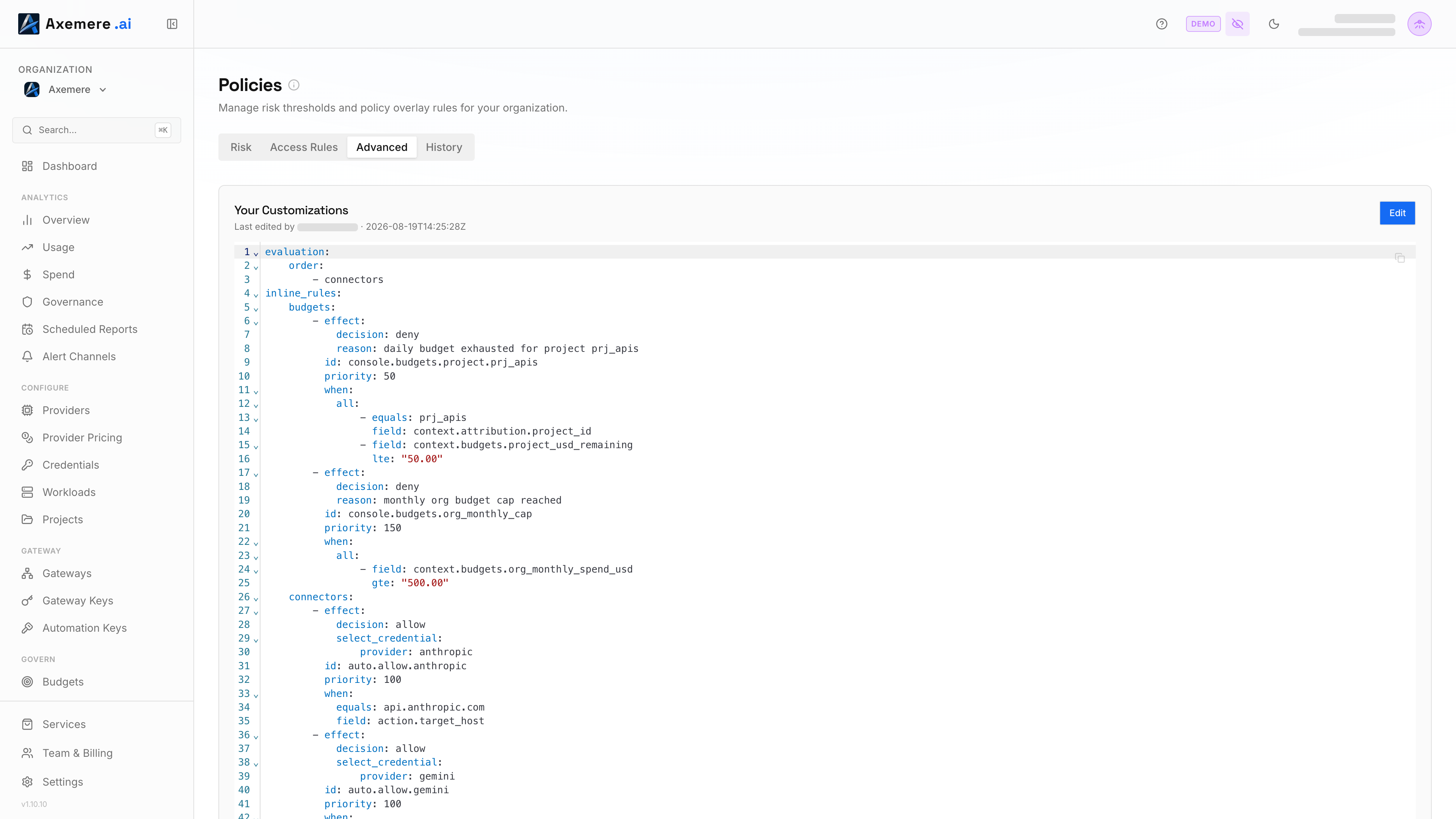
The add-on system gives you a Unix-style drop-in mechanism for policy rules. Every rule file in the available/ catalog is inactive by default; placing a symlink (or copy) in addons/ activates it. The gateway loads all .yaml files from addons/ on startup, following symlinks automatically.
<MVGC_POLICIES_DIR>/
├── bundle.yaml              <- skeleton: evaluation config, no inline rules
├── available/               <- catalog of all rule files (always present, inactive)
│   ├── core-identity.yaml
│   ├── provider-openai.yaml
│   ├── provider-anthropic.yaml
│   ├── provider-gemini.yaml
│   ├── provider-azure-openai.yaml
│   ├── provider-cohere.yaml
│   ├── deny-unknown-host.yaml
│   └── claude-cli-proxy.yaml
└── addons/                  <- active add-ons (symlinks or copies from available/)
    ├── core-identity.yaml          -> ../available/core-identity.yaml
    ├── provider-openai.yaml        -> ../available/provider-openai.yaml
    ├── provider-anthropic.yaml     -> ../available/provider-anthropic.yaml
    ├── provider-gemini.yaml        -> ../available/provider-gemini.yaml
    ├── provider-azure-openai.yaml  -> ../available/provider-azure-openai.yaml
    ├── provider-cohere.yaml        -> ../available/provider-cohere.yaml
    └── deny-unknown-host.yaml      -> ../available/deny-unknown-host.yaml
claude-cli-proxy.yaml is in the catalog but not enabled by default. Users opt in.
Add-on catalog
| Add-on | Layer | What it does | Enabled by default |
|---|---|---|---|
core-identity | identity | Allows all three connection types (direct_api, sdk_redirect, connect_proxy) | Yes |
provider-openai | connectors | Routes api.openai.com -> cred-openai | Yes |
provider-anthropic | connectors | Routes api.anthropic.com -> cred-anthropic | Yes |
provider-gemini | connectors | Routes generativelanguage.googleapis.com -> cred-gemini | Yes |
provider-azure-openai | connectors | Routes *.openai.azure.com -> cred-azure-openai | Yes |
provider-cohere | connectors | Routes api.cohere.com -> cred-cohere | Yes |
deny-unknown-host | connectors | Catch-all deny (priority 500) for any unmatched target host | Yes |
claude-cli-proxy | connectors | Passthrough rules for claude.ai, statsig.anthropic.com, sentry.io -- used when proxying Claude Code CLI | No |
Enabling and disabling add-ons
Use the mvgc-gateway addon subcommand to manage add-ons:
# List all available add-ons and their enabled/disabled status
mvgc-gateway addon list

# Enable the Claude CLI proxy add-on
mvgc-gateway addon enable claude-cli-proxy

# Disable an add-on
mvgc-gateway addon disable provider-cohere

# Apply changes without restarting
curl -s -X POST http://localhost:7080/v1/admin/policies/reload \
  -H "MVGC-Admin-Token: $MVGC_ADMIN_TOKEN" | jq .
The addon enable command creates a symlink in addons/ pointing to available/<name>.yaml. The addon disable command removes the symlink. Call POST /v1/admin/policies/reload to pick up the change immediately -- no restart needed.
CP-connected gateways: syncing addon state from the control plane
When your gateway is connected to a control plane, the org admin enables and disables
add-ons from the console. Use addon sync to pull that state down to the local
filesystem so it survives offline periods:
# Reconcile local addon symlinks with the CP's enabled state for this org
MVGC_CP_ADDR=cp.example.com:9090 \
MVGC_ORG_ID=org-abc123 \
MVGC_CP_TOKEN=$MVGC_CP_TOKEN \
mvgc-gateway addon sync
addon sync calls ListAddons on the CP and then enables or disables local symlinks
to match. Add-ons that are enabled in the CP but whose YAML is not installed locally
are skipped with a warning (upgrade the gateway package to get the latest catalog).
| Env var | Required | Description |
|---|---|---|
MVGC_CP_ADDR | Yes | Control plane gRPC address (e.g. cp.example.com:9090) |
MVGC_ORG_ID | Yes | Org ID whose addon state to sync |
MVGC_CP_TOKEN | No | Bearer token for CP authentication |
MVGC_CP_CA_CERT | No | Path to CA cert PEM for CP TLS verification |
MVGC_CP_SKIP_TLS_VERIFY | No | Set true to skip TLS cert verification (dev only) |
MVGC_CP_NO_TLS | No | Set true to disable TLS entirely (local/test only) |
The command is idempotent: safe to run on every deploy or from a cron job.
MVGC_POLICIES_DIR controls where the gateway looks for both available/ and addons/. The default is configs/policies/ relative to the working directory; installed packages set it to the installation-specific path.
Claude Code CLI proxy example:
Claude CLI contacts four hosts; only one is an AI API endpoint:
| Host | Traffic type | Gateway handling |
|---|---|---|
api.anthropic.com | AI API calls | Governed -- Anthropic connector, credential injection, metering |
claude.ai | Auth / web | Passthrough -- original headers forwarded unchanged |
statsig.anthropic.com | Feature flags / telemetry | Passthrough |
sentry.io | Error reporting | Passthrough |
# Enable the add-on and reload (no restart needed)
mvgc-gateway addon enable claude-cli-proxy
curl -s -X POST http://localhost:7080/v1/admin/policies/reload \
  -H "MVGC-Admin-Token: $MVGC_ADMIN_TOKEN" | jq .

# Set your Anthropic key and point Claude CLI at the gateway
export ANTHROPIC_API_KEY=sk-ant-...
export HTTPS_PROXY=http://localhost:7080
claude "Hello"
If the gateway terminates TLS with its own certificate, also set:
export NODE_EXTRA_CA_CERTS=/path/to/mvgc-ca.crt
How passthrough works: A rule with
decision: allowand noselect_credentialcauses the gateway to forward the request through the generic HTTP connector with all original client headers intact. No API key injection occurs.
How to create your own add-on
An add-on is a YAML rule file with the mvgc.rule_file.v1 schema and a single layer tag. It follows the same format as any other rule file (see section 3.2).
Step 1 -- Write the rule file
Place it in <MVGC_POLICIES_DIR>/available/. The filename (without .yaml) becomes the add-on name.
# available/provider-my-llm.yaml
schema: mvgc.rule_file.v1
layer: connectors
rules:
  - id: proxy.allow.my-llm
    priority: 100
    when:
      field: action.target_host
      equals: api.my-llm-provider.example
    effect:
      decision: allow
      select_credential: cred-my-llm
      reason: "my-llm provider routed"
Step 2 -- Verify it appears in the catalog
mvgc-gateway addon list
# ADDON                  LAYER       RULES  ENABLED
# core-identity          identity    2      true
# deny-unknown-host      connectors  1      true
# ...
# provider-my-llm        connectors  1      false   <- your new add-on
Step 3 -- Enable it
mvgc-gateway addon enable provider-my-llm
# Restart the gateway to activate
Rule file schema reference:
| Field | Type | Description |
|---|---|---|
schema | string | Must be mvgc.rule_file.v1 |
layer | string | Which evaluation layer these rules belong to (identity, connectors, etc.) |
rules | []Rule | List of rules -- same format as any other rule file (see section 3.3) |
Guidelines for add-on authors:
- Use a consistent naming convention:
<category>-<name>.yaml(e.g.,provider-openai.yaml,core-identity.yaml) - Choose a priority that fits within the existing range. Provider add-ons use priority 100; the catch-all deny (
deny-unknown-host) uses priority 500 - Add-ons should be self-contained -- avoid rules that depend on variables set by another add-on
- Test with
mvgc-gateway addon listto verify the rule count and layer are parsed correctly before enabling
4. Pushing policies at runtime
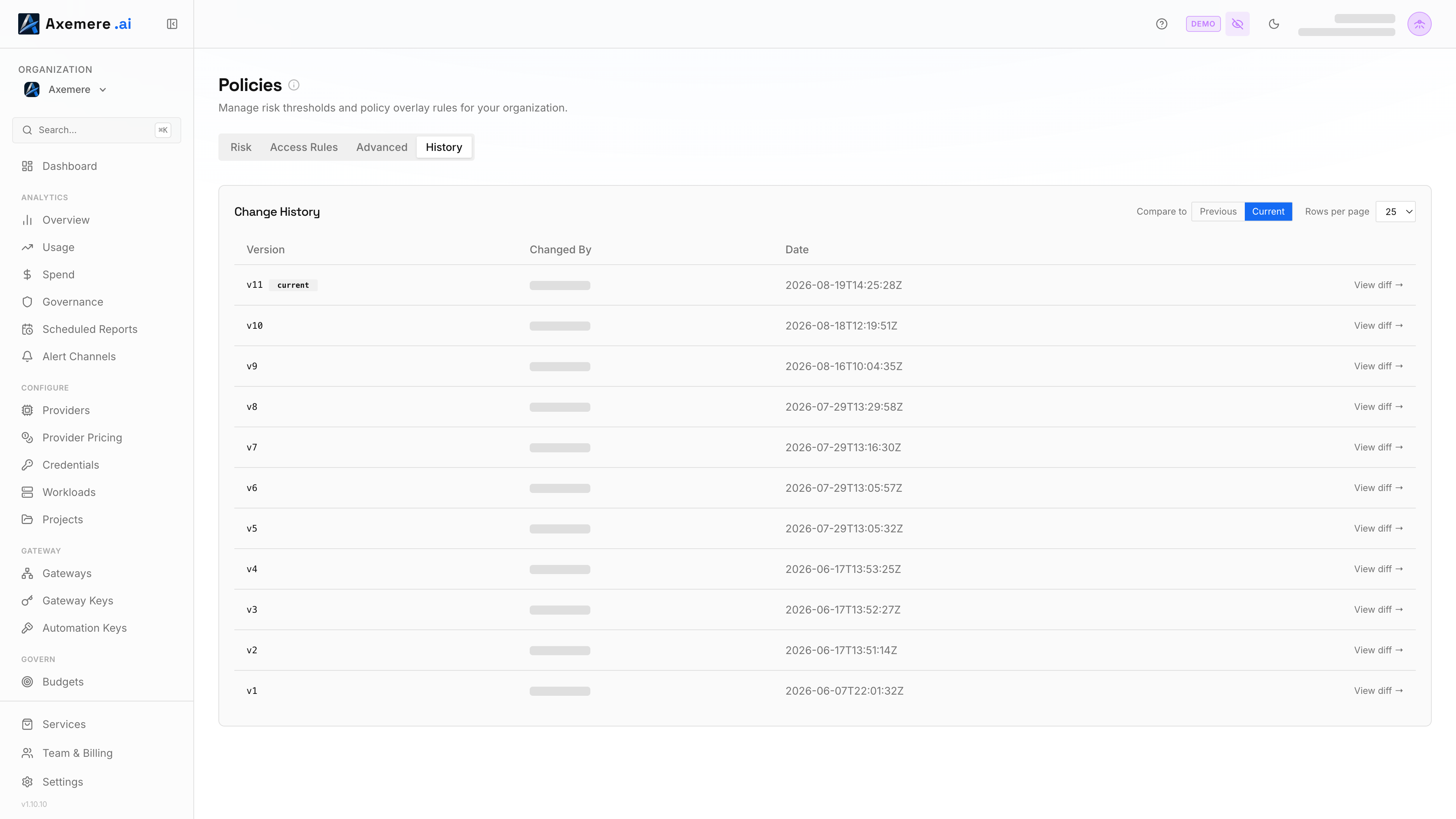
Update the active policy bundle
curl -X PUT http://localhost:7080/v1/admin/policies \
  -H "MVGC-Admin-Token: $MVGC_ADMIN_TOKEN" \
  -H "Content-Type: application/yaml" \
  --data-binary @configs/policies/bundle.yaml
Inspect active policy bundle
curl http://localhost:7080/v1/admin/policies \
  -H "MVGC-Admin-Token: $MVGC_ADMIN_TOKEN"
5. Policy file locations by installation method
The gateway loads policy files from the directory pointed to by MVGC_POLICIES_DIR. The default path depends on how the gateway was installed. Credentials are managed separately via the admin API and are not written to disk by the installer.
Quick reference
| Installation method | Policy files | Main config (mvgc.yaml) |
|---|---|---|
| Linux .deb / .rpm | /etc/mvgc/policies/ | /etc/mvgc/mvgc.yaml |
| macOS Homebrew | $(brew --prefix)/var/mvgc/configs/policies/ | $(brew --prefix)/etc/mvgc/mvgc.yaml |
| Docker Compose | /configs/policies/ (baked into image; no bind mount) | env vars in .env |
| Kubernetes / Helm | /configs/policies/ (from ConfigMap) | env vars + Kubernetes Secret |
| Tarball (manual) | configs/policies/ (relative to working directory) | mvgc.yaml (at tarball root) |
Linux packages (.deb / .rpm)
The installer places all policy files under /etc/mvgc/policies/ and marks them config|noreplace, meaning package upgrades will not overwrite files you have edited.
/etc/mvgc/mvgc.yaml                          <- main config (config|noreplace)
/etc/mvgc/policies/bundle.yaml               <- skeleton bundle (loads from addons/ on startup)
/etc/mvgc/policies/available/                <- add-on catalog
/etc/mvgc/policies/available/core-identity.yaml
/etc/mvgc/policies/available/provider-openai.yaml
/etc/mvgc/policies/available/provider-anthropic.yaml
/etc/mvgc/policies/available/provider-gemini.yaml
/etc/mvgc/policies/available/provider-azure-openai.yaml
/etc/mvgc/policies/available/provider-cohere.yaml
/etc/mvgc/policies/available/deny-unknown-host.yaml
/etc/mvgc/policies/available/claude-cli-proxy.yaml
/etc/mvgc/policies/addons/                   <- active add-ons (symlinks into available/)
/etc/mvgc/policies/addons/core-identity.yaml
/etc/mvgc/policies/addons/provider-openai.yaml
/etc/mvgc/policies/addons/provider-anthropic.yaml
/etc/mvgc/policies/addons/provider-gemini.yaml
/etc/mvgc/policies/addons/provider-azure-openai.yaml
/etc/mvgc/policies/addons/provider-cohere.yaml
/etc/mvgc/policies/addons/deny-unknown-host.yaml
/etc/mvgc/credentials/credentials.yaml       <- credential seed (config|noreplace)
/etc/mvgc/workloads/workloads.yaml           <- workload seed (config|noreplace)
/usr/bin/mvgc-gateway                        <- binary
/lib/systemd/system/mvgc-gateway.service
The systemd service reads MVGC_POLICIES_DIR from /etc/default/mvgc-gateway. To point the gateway at a different policy directory, edit that file and restart the service:
# Edit the default config
sudo nano /etc/default/mvgc-gateway
# MVGC_POLICIES_DIR=/etc/mvgc/policies  <- change if needed

# Restart
sudo systemctl restart mvgc-gateway

# Or push a new bundle live without restarting
curl -X PUT http://localhost:7080/v1/admin/policies \
  -H "MVGC-Admin-Token: $MVGC_ADMIN_TOKEN" \
  -H "Content-Type: application/yaml" \
  --data-binary @/etc/mvgc/policies/mvp_policy.yaml
macOS Homebrew
Homebrew installs the config under etc/ and policy files under var/ (following the convention that etc/ is for configuration and var/ is for mutable runtime data).
$(brew --prefix)/etc/mvgc/mvgc.yaml                                              <- main config
$(brew --prefix)/var/mvgc/configs/policies/bundle.yaml                          <- skeleton bundle
$(brew --prefix)/var/mvgc/configs/policies/available/                           <- add-on catalog
$(brew --prefix)/var/mvgc/configs/policies/available/core-identity.yaml
$(brew --prefix)/var/mvgc/configs/policies/available/provider-openai.yaml
$(brew --prefix)/var/mvgc/configs/policies/available/provider-anthropic.yaml
$(brew --prefix)/var/mvgc/configs/policies/available/provider-gemini.yaml
$(brew --prefix)/var/mvgc/configs/policies/available/provider-azure-openai.yaml
$(brew --prefix)/var/mvgc/configs/policies/available/provider-cohere.yaml
$(brew --prefix)/var/mvgc/configs/policies/available/deny-unknown-host.yaml
$(brew --prefix)/var/mvgc/configs/policies/available/claude-cli-proxy.yaml
$(brew --prefix)/var/mvgc/configs/policies/addons/                              <- active add-ons
$(brew --prefix)/var/mvgc/configs/policies/addons/core-identity.yaml           -> ../available/...
$(brew --prefix)/var/mvgc/configs/policies/addons/provider-openai.yaml         -> ../available/...
$(brew --prefix)/var/mvgc/configs/policies/addons/provider-anthropic.yaml      -> ../available/...
$(brew --prefix)/var/mvgc/configs/policies/addons/provider-gemini.yaml         -> ../available/...
$(brew --prefix)/var/mvgc/configs/policies/addons/provider-azure-openai.yaml   -> ../available/...
$(brew --prefix)/var/mvgc/configs/policies/addons/provider-cohere.yaml         -> ../available/...
$(brew --prefix)/var/mvgc/configs/policies/addons/deny-unknown-host.yaml       -> ../available/...
$(brew --prefix)/var/mvgc/configs/credentials/credentials.yaml                 <- credential seed
$(brew --prefix)/var/mvgc/configs/workloads/workloads.yaml                     <- workload seed
$(brew --prefix)/bin/mvgc-gateway                                               <- binary
$(brew --prefix)/var/log/mvgc/gateway.log                                       <- log output
On Apple Silicon the prefix is /opt/homebrew; on Intel it is /usr/local. To find your prefix: brew --prefix.
The launchd service sets MVGC_CONFIG to the installed mvgc.yaml. Edit that file to set your API key env vars and MVGC_ADMIN_TOKEN, then:
# Start (or restart) the service
brew services restart mvgc-gateway

# Or push a new bundle live without restarting
curl -X PUT http://localhost:7080/v1/admin/policies \
  -H "MVGC-Admin-Token: $MVGC_ADMIN_TOKEN" \
  -H "Content-Type: application/yaml" \
  --data-binary @"$(brew --prefix)/var/mvgc/configs/examples/mvp_policy.yaml"
Docker Compose
The customer-facing compose files (docker-compose.yaml and docker-compose.postgres.yaml) do not bind-mount a host configs/ directory. Policy files are baked into the image at /configs/policies/ and used as-is. Configuration is supplied entirely through environment variables in .env.
To push a policy bundle at runtime (no restart needed):
curl -X PUT http://localhost:7080/v1/admin/policies \
  -H "MVGC-Admin-Token: $MVGC_ADMIN_TOKEN" \
  -H "Content-Type: application/yaml" \
  --data-binary @my-bundle.yaml
To supply custom policy files via a volume mount, use docker run directly (see the Docker and Podman guide for the three mount options).
To restart the gateway to pick up .env changes:
docker compose restart gateway
Kubernetes / Helm
The Helm chart stores policy files in a Kubernetes ConfigMap and mounts it at /configs/policies/ inside the gateway pod. MVGC_POLICIES_DIR is set to /configs/policies by default.
Kubernetes resource                 Mount path in pod
─────────────────────────────────── -> ────────────────────────────
ConfigMap: <release>-policies       /configs/policies/
  bundle.yaml, available/*.yaml,
  addons/*.yaml (symlinks)
ConfigMap: <release>-credentials    /configs/credentials/
  credentials.yaml
ConfigMap: <release>-workloads      /configs/workloads/
  workloads.yaml
Secret: (user-managed)              env vars injected via envFrom
  DATABASE_URL, MVGC_ADMIN_TOKEN
To update policy files:
# Push a bundle live via admin API (no restart required)
curl -X PUT http://localhost:7080/v1/admin/policies \
  -H "MVGC-Admin-Token: $MVGC_ADMIN_TOKEN" \
  -H "Content-Type: application/yaml" \
  --data-binary @configs/examples/mvp_policy.yaml
Credentials are never stored in the ConfigMap. Inject them as environment variables via a Kubernetes Secret or an external secrets manager, referenced in values.yaml under adminToken.existingSecret and extraEnv.
Tarball (manual install)
The Linux release tarball extracts to a directory containing the binary, the main config, and the policy files:
mvgc-gateway                                             <- binary
mvgc.yaml                                                <- main config
configs/policies/bundle.yaml                             <- skeleton bundle
configs/policies/available/core-identity.yaml            <- add-on catalog
configs/policies/available/provider-openai.yaml
configs/policies/available/provider-anthropic.yaml
configs/policies/available/provider-gemini.yaml
configs/policies/available/provider-azure-openai.yaml
configs/policies/available/provider-cohere.yaml
configs/policies/available/deny-unknown-host.yaml
configs/policies/available/claude-cli-proxy.yaml
configs/policies/addons/core-identity.yaml               <- active add-ons (symlinks)
configs/policies/addons/provider-openai.yaml
configs/policies/addons/provider-anthropic.yaml
configs/policies/addons/provider-gemini.yaml
configs/policies/addons/provider-azure-openai.yaml
configs/policies/addons/provider-cohere.yaml
configs/policies/addons/deny-unknown-host.yaml
configs/credentials/credentials.yaml                     <- credential seed
configs/workloads/workloads.yaml                         <- workload seed
Set MVGC_POLICIES_DIR to the absolute path of the configs/policies/ directory before starting the gateway:
export MVGC_POLICIES_DIR=/opt/mvgc/configs/policies
export MVGC_ADMIN_TOKEN=your-admin-token
export DATABASE_URL=postgres://...
./mvgc-gateway
See also
- Configuration Overview -- how credentials, workloads, and policies interrelate
- Credentials -- credential reference: provider values, modes, secret resolution
- Workloads -- workload reference: default attribution, ingress modes